Wednesday, October 20, 2010

Bipolar Disorder


Many who suffer from Bipolar begin to experience symptoms in childhood or adolescence but go through various treatment methods and diagnosis prior to being actually diagnosed and treated for Bipolar. Bipolar at onset is different for all who experience it. It may present as depressive or manic or both and even the depressive and manic symptomology can manifest as a range of varying degrees of mood instability. One may present as tired and withdrawn or irritable and be depressed. One may lose their appetite altogether or have very little need for sleep. Manic phases may be observed as a person being very impulsive and driven with a grandiose sense of self or suicidal and delusional, seeming out of touch with reality. There are as many manifestations of bipolar as there are individuals who cope with it. Patterns are there, criteria are met, but it all takes on the distinct flavor of those who must live within its scope everyday of their lives. It can be tough to face and a mystery to those to whom it is merely today’s disorder of note.

There is hope for those who are challenged with bipolar. There are medications that are highly effective, often taken in combination, to combat the diverse symptomology. There are psychotherapies (talk therapy) and cognitive behavioral treatments which address thinking errors. There are community support groups which can increase coping skills and allow participants to practice socializing in a safe and known environment. A weekly adult support group will begin on Monday, October 25 from 5:30 – 6:30 PM. If you or someone you care about could benefit from such a group, please call (386)747-9858 for details.


by: Janice Suskey, M.Ed. Ed.S. LMHC

Tuesday, October 19, 2010

Childhood Obesity


The Mayo clinic staff defines childhood obesity as occurring when, “a child or adolescent is well above the normal weight for his or her age and height”. The primary concerns of childhood obesity can lead to more serious health conditions such as heart disease, diabetes, high blood pressure, bone and joint issues, sleep apnea and high cholesterol. From a mental health standpoint, there is real concern about the child’s self esteem, use of emotional eating and depression.

According to the Center for Disease Control, childhood obesity has more than tripled in the last thirty years. Parents are often informed during routine physicals at the pediatrician’s office of their child’s BMI (body mass index). The BMI is calculated by measuring the child’s height and weight and comparing the child on a percentile rating scale to other child his or her age of the same height and weight. The center for disease control established the rankings that determine what is considered overweight.

Addressing childhood obesity should be done through proper consultation with your pediatrician. Involving the family in good eating patterns and a more active lifestyle is a win-win situation for the entire family.

The mental health issues that can arise from this problem can be quite serious. Obese children often become targets of bulling, shy away from activities that require wearing a bathing suit, have difficulty playing sports, develop body image issues, experience low self esteem, have nervousness or anxiety symptoms and even depression symptoms.

Signs and symptoms to look for that your child may be experiencing emotional problems related to obesity are:
You notice your child has become withdrawn, shy or self isolates
Your child does not want to go to school
Your child is showing a preoccupation with food
Your child is sleeping too long
Your child is cutting him or herself
Your child is verbalizing threats of harming him or herself

If you notice any of theses signs in your child, please contact our office to set up an evaluation for your child, at 386-736-9165.

Jennifer Nadelkov, MA, LMFT

Sunday, October 17, 2010

How's Your Day?

Ever have "one of those days?" Maybe even one of those weeks? Sometimes it can feel as though our day gets away from us, and we are not even sure how. One thing for us to be aware of is our attitude and how we respond to certain situations. Here's an example.....

Have you had a morning, where in your waking up process you maybe stub your toe on the corner of the bed or dresser? I have, and generally I'm left with one of two trains of thought, either: that's a bad way to start today, my day will probably be bad; or ouch! well my day can only get better from here. On the days I go with the first thought process, everything has a negative shade to it, kind of like I'm being followed by Charlie Brown's rain cloud. Traffic is horrible, that person just cut me off, and I tend to be more sensitive to the way in which people talk with me (boy that person really has an attitude today). On the days when I take the mindset that things can only get better from here, the same traffic situation is now normal, not horrible; the person who cut me off, I'm paying more attention to and prepare for it, so it does not bother me; and I tend to see the way in which people are interacting with me in a more positive manner. The mindset I start the day with not only influences the way in which I perceive my day, but additionally it has either a negative or positive impact on my energy level for the day.

Now the example I have given was stubbing my toe, but stubbing my toe could also be your children waking you up early, siblings arguing with each other, a comment from your partner, any one of a thousand things. It is important to be aware of how we are feeling, and if we are upset, identify why we are upset and try to reframe it through a more positive lens. The great thing about our attitudes and perceptions is that we have the power at any point throughout our day, to re-start our day. If we notice that we have allowed the negative thought processes to take over, we can stop, perform some sort of starting over process and begin our day anew. For me, when I have identified that I have allowed my negative mindset to take over, I try to get a minute or two to myself, take several deep breathes, and give myself a little pep talk. Whatever you do, make it personal to yourself, and give yourself the opportunity to have a great day!

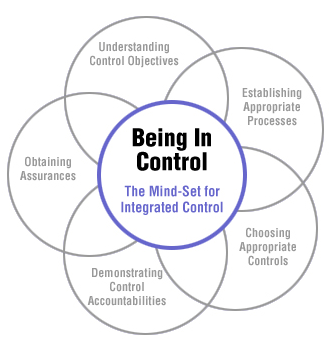
In Control or In Charge?


An accident in the blink of an eye, a partner decides to leave the relationship, hurricane force winds destroy a home; these things happen so fast and are beyond our control. Depression, anxiety, obsessions-compulsions, these come on fast or gradually and are beyond are control.

We talk of “being in control” but the truth is that we are never as “in control” as we like to think we are. Life is cumulative. Events, reactions, and patterns form prior to the time we are even able to be conscious of them.


A better way for us to think, instead of control, is to learn how to be “in charge”. In charge implies something completely different than in control. In charge implies a willingness to make decisions about what happens to us and also invites input from other sources that can be taken into consideration or ignored. In charge is to delegate to others the responsibility that belongs to them and encourage them in that responsibility. In control is just the opposite.


We may not have control over things that come to us, but we can, with help and support, learn how to be in charge of the effect anxiety, depression, anger, obsessions, moods, other people and events has over us. Don’t hesitate. Do your life the honor of learning how to take charge, today.

Monday, October 11, 2010

Step Grandparents


There are a few different scenarios that might place you in the role of being a step grandparent. For the stepparent the expectations of how they prefer their stepchildren be integrated into the family could vary. To date there is little research on the expectations of step grandparents. The primary goal of stepfamilies is to build a bridge to unify two separate entities into one, while not building a wall that blocks the old family unit or unit(s) from being a part of the new family. As the step grandparent you may struggle with managing old loyalties while trying to build new loyalties.
Typically after divorce and remarriage a child will look to his or her Grandparents for support and a sense of normalcy among the many changes they are facing. Children that are not forced to relocate have an easier chance at maintaining those close bonds with Grandparents. Step grandchildren may be forced to relocate and may have limited access to their new step grandparent and biological grandparent. This factor can create difficulty in trying to establish a bond with the child.
Some Grandparents provide a lot of emotional, financial and even childcare responsibilities for their children’s children while the initial marriage is ending. This can cause caretaker fatigue, which can result in Grandparents being emotionally exhausted and “taking a break” while the stepfamily is bonding. This intergenerational dependency is not a new phenomenon, although is becoming more and more common as the divorce rate increases. The step grandchild is not usually around for the marriage dissolution, thus the child could experience some confusion as to why the step grandparent is not a part of their everyday life.
Step grandparents have often been blessed with the honor of being a part of their biological grandchildren’s births and subsequent major milestones. However, with step grandchildren, depending on their age, a lot of milestones have already happened. This can pose a difficult dilemma for the Grandparent who has adored their biological grandchild since birth and is now trying to bond with a step grandchild that they know very little about.
If you or a loved one has recently found themselves in the position of being a step grandparent, be assured you are not alone in your struggle to adjust to your new family dynamics. Redefining relationships can be a difficult task, although is not a hopeless situation. If you are interested in getting more information on this topic, please contact our office at 386-736-9165.

Jennifer Nadelkov, MA, LMFT

Sunday, October 10, 2010

Don't put off until tomorrow, what you could do to....


Ever have an assignment at work, or a project at home, that always seems to be on your "to do" list, yet you never quite get to it? If you are anything like me, you do. This is commonly referred to as procrastination. Procrastination is defined by www.dictionary.com as "to defer an action; to procrastinate until an opportunity is lost." But what really are the negative effects of procrastinating?
There can be negative physical, employment and relational effects due to procrastination. Procrastination can lead to stress, depression and low self-esteem. Procrastination can have a negative economic impact as well. If people put off paying their bills, they might have to incur penalties, fees or maybe reconnection costs. Additionally, a person's credit score could then be impacted, thusly affecting a person's ability to purchase a car, home or other necessities. In the career world, procrastinating on projects can have a person labeled as lazy, lead to cluttered work areas, and missed career advancement. Finally, in relationships, people can become angry, annoyed, or frustrated when someone tells them they will do something and they don't come through.
Here are a few tips to help you overcome procrastination:
1. If a project or assignment seems overwhelming, break it into smaller tasks, to help you feel like it is more achievable. How would you eat an elephant? One bite at a time.
2. Set yourself a timer to accomplish tasks. For example complete all your phone calls within a thirty minute time period.
3. Be aware of the messages you send yourself, they impact your motivation. Instead of using phrases such as "I should" or "I have to" which can lead to a negative thought process, try using more positive phrases such as "I choose to" or"I want to."
4. Organize...organize...organize. Set yourself a schedule, and prioritize the things that need to be completed in order of time/importance.
5. Reward yourself for not procrastinating. Provide yourself with little incentives as a means of accomplishing your tasks.

Wednesday, October 6, 2010

Relationships


“You must pay the rent!” the Landlord rants, “But I can’t pay the rent” pleads the put-upon renter, enters the rescuer, “I will pay the rent”! Ah, peace reigns; but at what price?

These roles (that of victim, abuser, and caregiver) are often played out in stories, movies, plays, and music are the stuff of life. They hit a common thread with many people because the truth is, most of us, have played one or all of these roles more than once in relationships either at work, school, socially, or with our families. How many times have you complained and whined (victim) about a situation in your relationship with a friend or loved one, only to find yourself caving and giving in to whatever the demand, behavior or request is you are complaining about (caregiver), then griped (abuser) about the outcome and your sacrifice either to the person you caved in to or to someone else about the person you gave in to?

“That’s just human nature.” you say. True, but it is also one of the most ultimately destructive dynamics to human relationships there is. It is the push-me-pull-you of a no win situation in which neither party is satisfied however the dynamic keeps interaction going in such a way that it simulates intimacy by creating engagement without ever honestly taking ownership or straight forwardly asking for what one needs. In the long run, both parties will typically become worn out and disengage rather than go through profitless engagements or believe they are engaging and engage for engagements sake, repeating the cycle, whether or not it’s productive, for the sake of the habit which simulates intimacy at the price of never really getting close.

Our ultimate goal as evolved people is to be able to be clear with ourselves and our most important relationships as to our feelings, thoughts, and behaviors in a genuine way as we progress through and process life events. This requires us to know ourselves and be willing to take ownership of all the pieces of who we are (weaknesses and strengths) and risk letting others know us as well. Sounds simple but for many of us it is a huge undertaking. Often we have not had the equipping or role models to live in such a congruent and clear manner and knowledge never has created change without some type of implementation.

So how do we become evolved to the point of genuine and honest behavior? Some will attempt to find reality in the most false God there is and turn to substances and alcohol in an attempt to “be who I am”. Others will create relationships that allow them to feel what they have always felt in the same way they have always felt it, thereby creating a “comfortable agony” in which the risk of change is not attempted at the price of upsetting the equilibrium of the known. What is clear is that the manifestation of a genuine and honest life is one we all know immediately when we encounter it. Our human interactions get bogged down in agenda, mistrust, and fear. To become genuine and honest takes practice and persistence. One must be willing to risk being real in relationship to another and that can be tough if you are not even sure what “real” is.

If you have not had relationships in which your feel genuineness has been possible in your family of origin (the family in which you grew up) it may be an uphill climb to create it for yourself as an adult but there is hope. If the dynamics written here strike home with you, call a licensed professional to learn how to break the circular pattern that keeps you in a cycle of ineffective, non-productive relationship.


Posted by: J. Suskey M. Ed. S.Ed. LMHC